
Foundation
Joe Kleinerman and the First Race of the Season

It turns out that as much as I wanted to treat this as some sort of elevated Livejournal, it is tough to find something insightful to write about every single day that I go for a run. So I took a few days to let things percolate.
The first two weeks of my Boston training block are under my belt. Week one was somewhat truncated because I started in earnest on January 1st but I managed 15.34 miles. Week two got a bit interesting - five runs over seven days for a total of 27.77 miles. This isn’t the kind of week to week increase that I’d recommend for anyone but I had a race and that pumped the numbers. It’s the most distance I’ve run in a week since just after the NYC Marathon and my body didn’t disintegrate so that’s encouraging. We’re rebuilding the foundation after a long time off. We’re right where we need to be. And racing is part of that foundation.
I’ll complain about running probably just as much as I’ll sing its praises but I love racing and for the first race of the season, this was a solid effort.
“The Heart & Soul of NYRR”
My first race of the season was also New York Road Runner’s first of the year: the Joe Kleinerman 10k. As running has grown exponentially since the height of the COVID-19 pandemic, it’s become commonplace to see local races in NYC and elsewhere sponsored by MasterCard or Citizens Bank or some other big corporation looking for some advertising and big tax write off. But NYRR reserves its first race of the year as a tribute to Joe Kleinerman, one of its founders and a giant in the road racing world.
Kleinerman was born in 1912 in Spring Valley, NY. His family had recently immigrated from Ukraine. He was the youngest of 4 and his running journey started the way it does for many in New York City. He attended the Millrose Games with his brother and caught the bug. From there, he would captain his cross country team at DeWitt Clinton High School as well as compete in the mile and half mile on the track.
He competed for City College and received a scholarship to Kansas State University but with the Great Depression bearing down, he returned home to work for the US Postal Service. He would keep that job for 32 years. By the 1940s, he had joined the Millrose Athletic Association and in 1941 and 1942, he placed top ten in the Boston Marathon. His best time was 2 hours, 38 minutes - quite a feat without the supershoes, energy gels and regularly placed water stations of today’s races.
As the United States formally entered World War II, Kleinerman would serve as Staff Sergeant in the US Army Air Corps. But he still found a way to run. He placed 5th in a race put together in Hawai’i by a slightly more famous Joe - one Joe DiMaggio.
After the war, he would become more involved with the Millrose Athletic Association, getting deeper into the administrative side of things as racial tensions were rising around the United States. Competitive running in the US was governed by the Amateur Athletics Union (AAU). They had many archaic restrictions such as women not being allowed to compete in distances over a mile and no recognition for runners in different age groups but worst of all was their refusal to take a stand against racial segregation. Kleinerman and other frustrated runners would start the Road Runners Club of America (RRCA) in 1958 to challenge the AAU’s road race sovereignty. Later that same year, Kleinerman, Ted Corbitt, Harry Murphy and 40 other runners would establish New York Road Runners.
Even as Kleinerman’s competitive days were further and further in the rear view, he worked tirelessly to make running accessible and inclusive. He championed women and people of color in the sport. It’s crazy to think that it wasn’t until 1967 that women were officially allowed to run competitive distances over a mile! And Joe would eventually put together a US women’s team for a 52 mile race from London to Brighton and that team won.
He passed on Veteran’s Day in 2003 at the age of 91. His friend Ted Corbitt would write this in his tribute: “I rated Joe as a good guy, a good friend to have, but short on patience and apparently grouchy at times. He had a great humanitarian heart….Joe Kleinerman gave more of himself to promote long distance running than any of the rest of us would consider doing under any voluntary circumstances.”
With the boom in popularity that running has endured over the past few years (especially in New York where the prospect of the New York City Marathon is a bucket list item for even the most casual of runners), it’s natural that NYRR has come under fire for some of its choices. But I’m happy to continue participating in an organization that does its best to honor the legacy of its founders through these races. And I’d hope that other runners aren’t ignoring the names of these events but are using them as an opportunity to engage more with this sport.
Race Report: #JoeK10K
So how was the race? Let’s get into it.
The course is a pretty standard loop of Central Park. The loop itself is a little over 6 miles so the start was on the east side around 97th Street and the finish was on the 102nd Street Transverse.
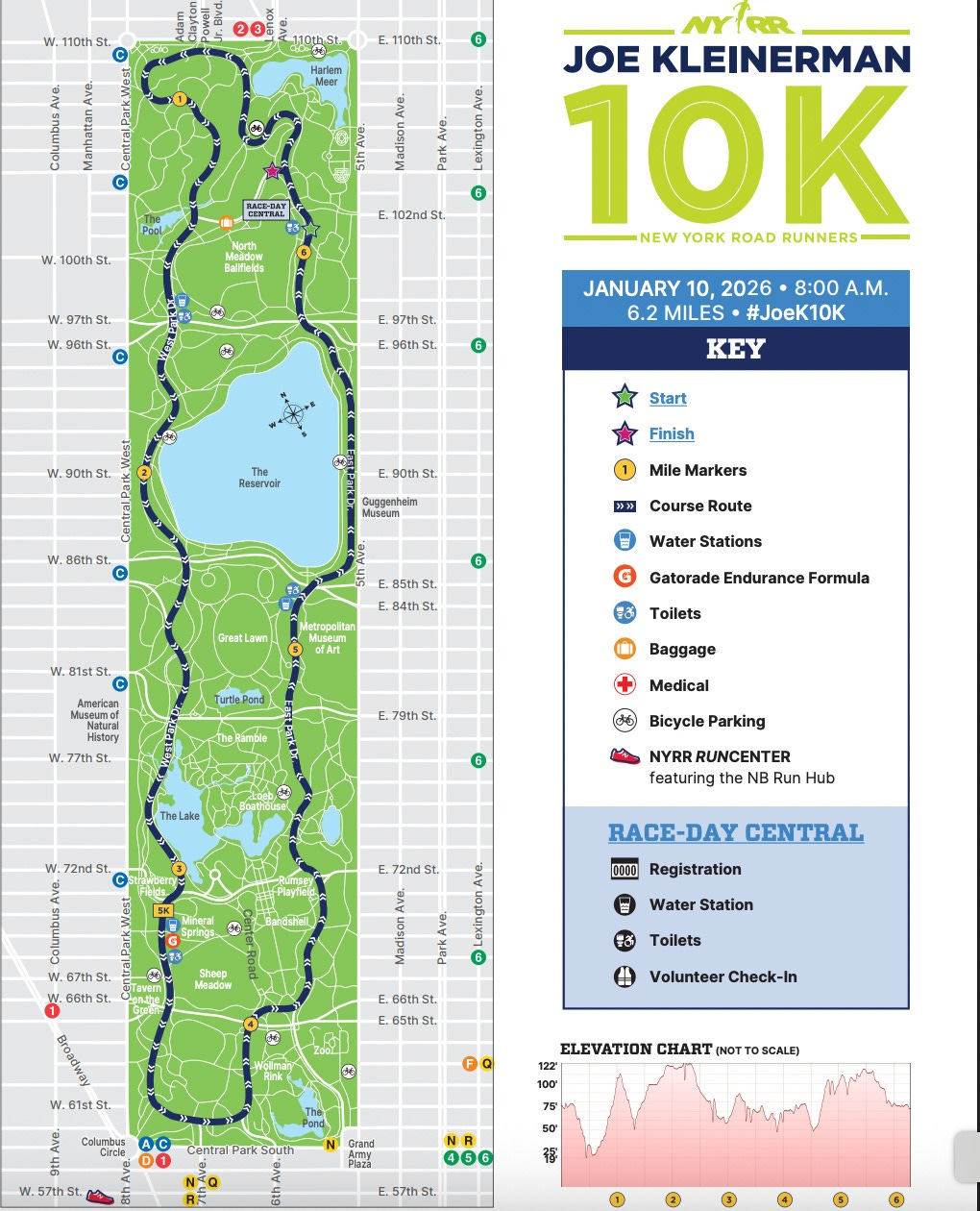
Central Park remains one of the absolute best places to train and one of the best places to race in all of NYC because of its varied elevations. Thankfully, the start was close to the biggest hill in the park, Harlem Hill, but while that’s the biggest I don’t think it’s the most challenging stretch of the race.
You hit the mile one marker at the top of the hill and things don’t get easier. The rolling hills of the Three Sisters test your might until around two and half miles in before the southern part of the park decides it wants to take its pound of flesh. The race doesn’t get “easy” until you conquer Cat Paw Hill and then pass Cleopatra’s Needle. (I’m realizing that this is sounding a lot like Olmec explaining the Temple Run at the end of each episode of Legends’ of the Hidden Temple.) Start you kick just after the Reservoir and you’re then you’re finished. That’s where the race actually gets easy.
My goal was 42 minutes. This race was really a way for me to set a baseline for my training block. I always race during my training because it’s the easiest way to see small improvements over time. I also think that folks forget they need to train that race day mental fortitude before their big one. You need to know how your body and your mind are going to react in times of great stress.
I told myself I’d take it easy on the first mile but I went out too hot. 6:24 on the first mile and it was largely downhill from there but I was able to maintain a sub 7 minute split every mile except for 5 where I hit 7:01. The end result ended up working out.
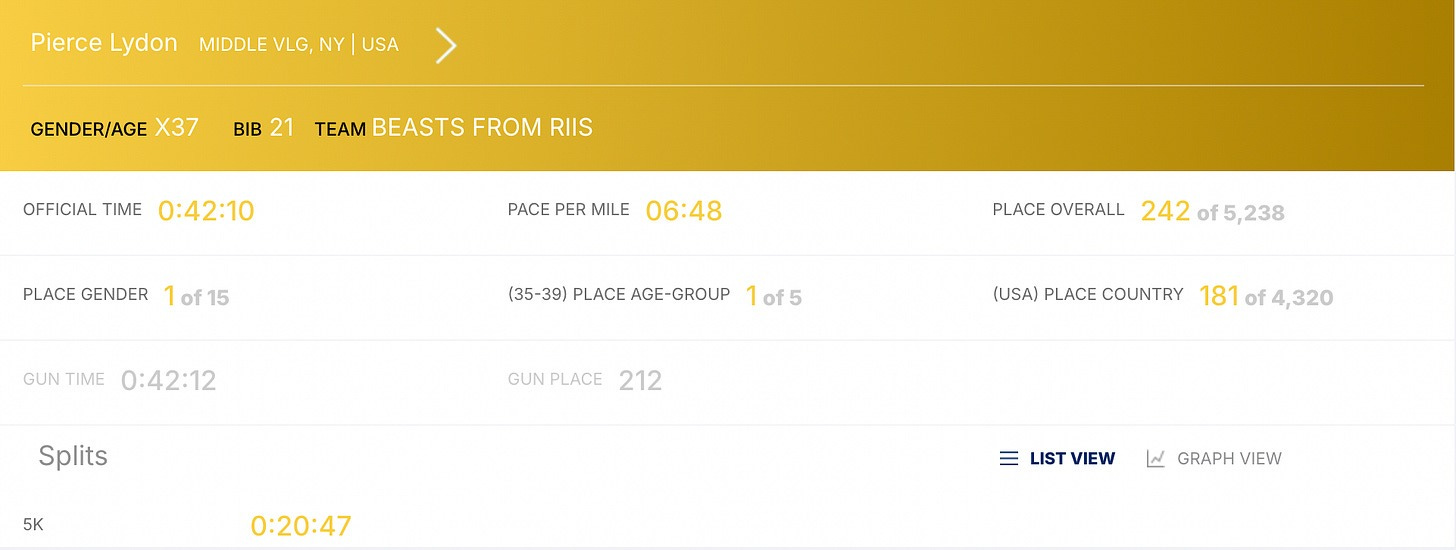
I’ll take that effort every day. But what did I learn from the race? Mostly that my breathing is not in the best place right now and my natural pacing is all out of wack. That first mile felt like I was going much faster but that’s because my fitness is not at the point where that level of exertion equals a faster pace. But we’ll get there. One encouraging sign is that while my splits aren’t machine-like, they don’t vary wildly.
Mile 1: 6:24
Mile 2: 6:43
Mile 3: 6:33
Mile 4: 6:53
Mile 5: 7:01
Mile 6: 6:44
The fact that I was able to bounce back after mile two and after mile five says to me that I was able to maintain a consistent effort level but that the course had other plans for how that effort level would translate on the clock. If I didn’t go out too fast on mile one, I might have had a little more in the tank to battle with miles two, four and five.
I’ve run Central Park hundreds of times. I should be better prepared. I know all this but the post-race recap always helps me get my mind right about how to attack it next time. And thank god, there’s always a next time.
What does training look like this week?
My first month of a training cycle is always about getting back to some level of volume. With the big jump in volume from weeks one to two, I’m looking to do a smaller one this week. My regular running route is about 6.4 miles so the aim is to get that done 5 times and clock in around 32 miles for the week. In February is when we’ll start incorporating speed work and getting that volume around the big 4-0.
"(I’m realizing that this is sounding a lot like Olmec explaining the Temple Run at the end of each episode of Legends’ of the Hidden Temple.)" - This is so good!